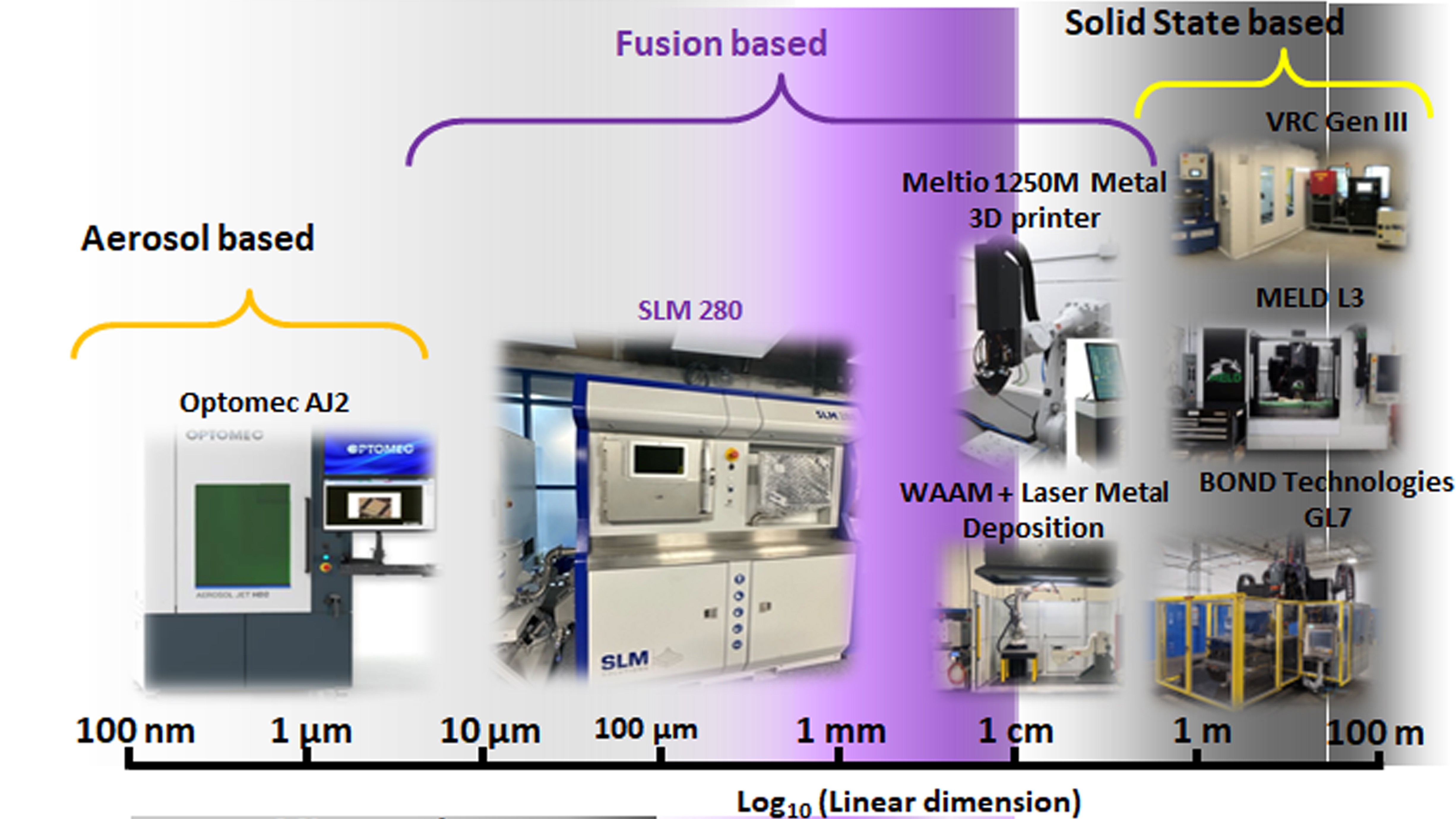


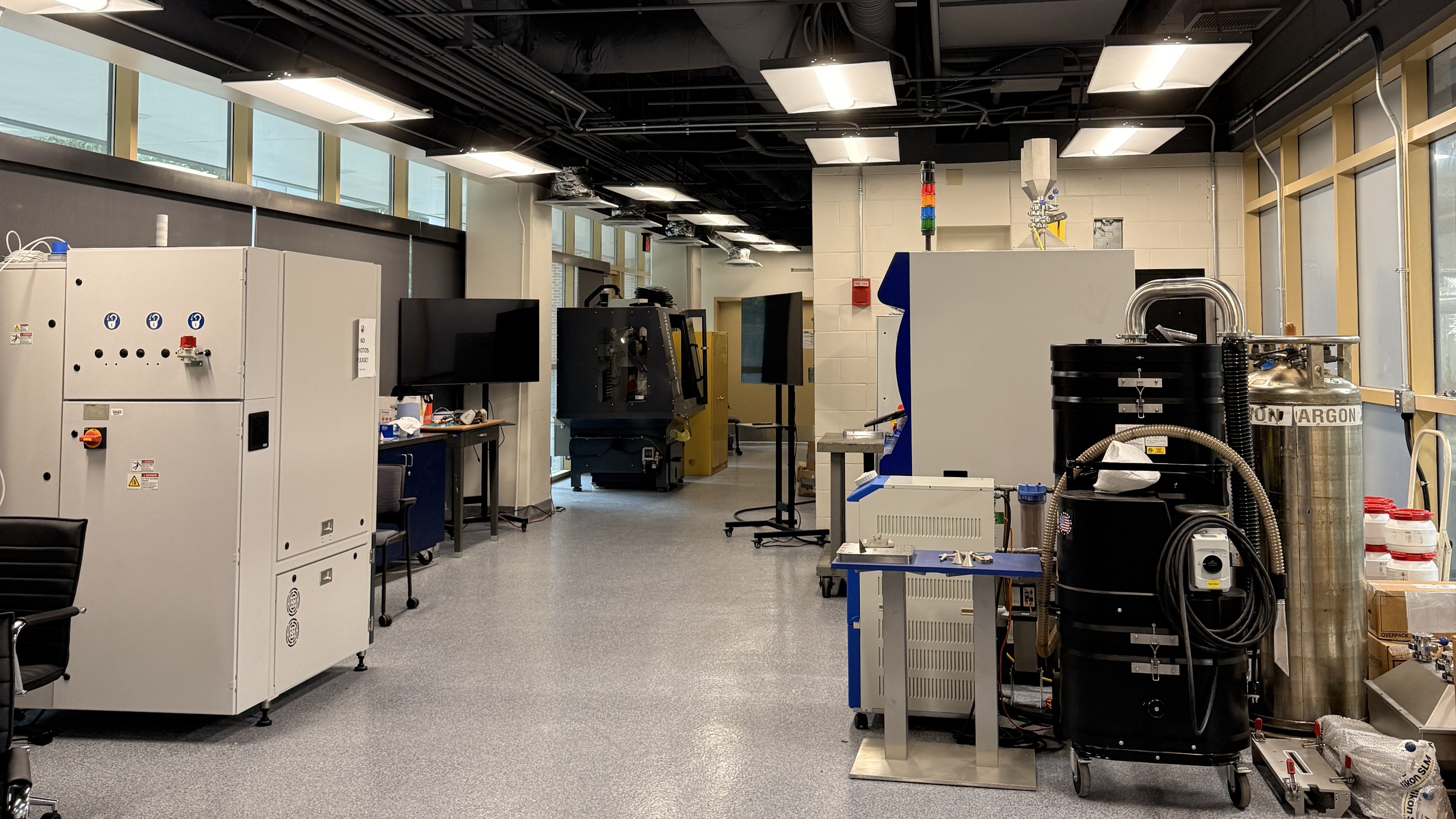


The NextGen Additive Manufacturing Research Laboratory (NextGen AMRL) is a multidisciplinary research center dedicated to advancing additive manufacturing (AM) science and technology through fundamental and applied research, workforce development, and industry collaboration. The laboratory provides state-of-the-art capabilities spanning materials development, process design and modeling, manufacturing, multiscale characterization, qualification, and technology transition. Its research encompasses a broad range of metallic, polymeric, ceramic, composite, and multimaterial systems, supporting applications in defense, aerospace, energy, transportation, and other commercial sectors.
NextGen AMRL integrates multi-scale, multimodal, intelligent, and sustainable manufacturing approaches to develop next-generation materials, components, and digital engineering solutions. By combining solid-state, fusion-based, aerosol-based, and hybrid additive manufacturing technologies with advanced sensing, artificial intelligence (AI), digital twins, and closed-loop process control, the laboratory addresses critical manufacturing challenges while promoting resource efficiency, circular manufacturing, and the replacement, repair, and sustainment of legacy components. Through partnerships with industry, government, and academia, NextGen AMRL accelerates technology qualification, certification, and deployment while educating and training the next generation of manufacturing professionals.
Current Research Thrusts
- Advanced Materials and Multimaterial Manufacturing: Development and processing of metallic, polymeric, ceramic, composite, and multimaterial systems for high-performance applications.
- Solid-State Additive Manufacturing: Research on Additive Friction Stir Deposition (AFSD), Cold Spray Additive Manufacturing (CSAM), Solid-Stir Additive Manufacturing (SSAM), and Ultrasonic Additive Manufacturing (UAM).
- Fusion-Based and Polymer Additive Manufacturing: Advancement of Laser Powder Bed Fusion (L-PBF), Laser Directed Energy Deposition (L-DED), Wire Arc Additive Manufacturing (WAAM), Large Format Additive Manufacturing (LFAM), and Selective Laser Sintering (SLS).
- Aerosol-Based Manufacturing: Development of Aerosol Jet Printing (AJP) for precision deposition and functional material integration.
- Process Modeling, Design, and Digital Engineering: Computational modeling, process simulation, data-driven design, AI-enabled manufacturing, digital twins, and closed-loop process control.
- Multiscale Materials Characterization and Qualification: Investigation of microstructure–property–performance relationships, mechanical behavior, process repeatability, and qualification and certification methodologies.
- Legacy Component Replacement and Lifecycle Extension: Replacement of conventionally cast and forged components, alongside repair, refurbishment, sustainment, and lifecycle extension using advanced additive manufacturing.
- Sustainable and Circular Manufacturing: Development of resource-efficient manufacturing processes, circular economy strategies, and value-added material reuse and upcycling.
- Expeditionary and Extreme-Environment Manufacturing: Advancement of point-of-need manufacturing capabilities for aerospace, defense, nuclear, energy, and in-space applications.
- Technology Transition and Workforce Development: Translation of laboratory research into industrial applications through collaborative partnerships, technology demonstration, and experiential education and training.